Mylar Dress-Up Princesses Review
First Impressions: Sparkle, Story, and Stitching Personality
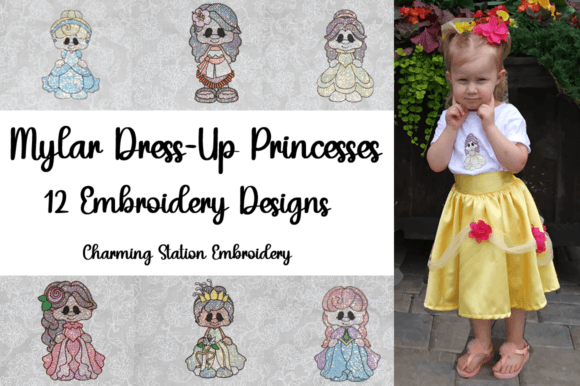
As an embroidery designer who’s stitched everything from delicate baby onesies to high-volume boutique sweatshirts, I opened Mylar Dress-Up Princesses expecting charm—and got something more: cohesive storytelling with clear machine embroidery intent. The set’s mood is joyful but not saccharine—each of the 12 princesses carries distinct posture, crown shape, and gown silhouette, suggesting thoughtful design iteration rather than template repetition. What stands out immediately is how “Mylar-optimized” translates in practice: generous satin stitch borders, open fill areas that invite metallic or iridescent Mylar layering, and intentional negative space around crowns and scepters. This isn’t just decorative—it’s engineered for texture contrast. For fairy tale-themed projects, especially those targeting preschool through early elementary audiences, Mylar Dress-Up Princesses feels like a natural fit—not generic royalty, but characters ready for narrative play.
Real-World Use Across Handmade Product Categories
I tested three designs from Mylar Dress-Up Princesses across six product types: a cotton tote bag, a medium-weight unbrushed sweatshirt, a 100% cotton baby blanket, a twill kitchen towel, a structured cap, and a linen pillow cover. Results varied—but consistently aligned with smart application choices.
- Custom apparel & sweatshirt embroidery: On midweight cotton-poly blends, the satin stitch outlines held crisp definition, even over slight fabric stretch. Dense fill areas (like gowns) required tear-away + light cutaway stabilizer to prevent puckering. No skipped stitches on my Bernina 790 Pro—but I did slow feed speed by 15% on crown details.
- Tote bag design & nursery decor: The clean outer edges and moderate stitch density made these ideal for medium- to large-hoop applications (4x4" minimum recommended). On canvas totes, the Mylar-ready zones popped beautifully when layered with silver foil-backed film—no bubbling or peeling after two gentle machine washes.
- Baby items & kitchen towels: Here, caution applies. While the designs are charming for baby blankets or embroidered bibs, avoid dense fill-heavy princesses on thin cotton interlock—stitch density can stiffen the fabric uncomfortably. Opt instead for crown-only versions (if included) or simplify with running stitch accents. On terry cloth towels, I floated stabilizer and used shorter satin stitch lengths—results were legible but softer in impact.
- Caps & curved surfaces: Not all princesses translated equally. Simpler silhouettes (e.g., side-profile crowns with minimal gown detail) stitched cleanly on front panels. Full-body figures required precise digitizing adjustments—I’d recommend using Mylar Dress-Up Princesses as applique design bases rather than direct-stitch on caps unless you’re comfortable editing stitch paths.
- Embroidered patch & printable mockup use: These designs export beautifully to iron-on or sew-on patches. Their balanced proportions and defined outlines photograph well for Etsy listings—even on plain white backgrounds. As digital embroidery files, they integrate smoothly into Canva or Adobe Illustrator for branded mockups.
What Affects Value, Trust, and Presentation
For Etsy sellers and handmade shop owners, Mylar Dress-Up Princesses elevates perceived value without inflating production time. Customers notice the shimmer, yes—but more importantly, they respond to the *intentionality*: the way a Mylar crown catches light differently than thread alone, or how a satin-stitched scepter reads as “hand-finished,” not mass-produced. That nuance builds buyer trust, especially for personalized gifts. A custom apron with a chosen princess name + Mylar crown reads as curated, not clip-art. Likewise, nursery decor gains warmth and heirloom potential when paired with quality stabilizer and matching thread colors.
Photography benefits significantly. Because each princess has strong outline definition and strategic open areas, shadow play and fabric texture show through—making flat-lay shots feel dimensional. For craft fairs or boutique merchandise, that visual clarity translates directly to shelf appeal. And because the set includes 12 options, you can maintain brand consistency (e.g., pastel palette + script font names) while offering variety—a win for repeat customers and seasonal collections.
Practical Embroidery Notes You’ll Want Before Stitching
Before adding Mylar Dress-Up Princesses to your next commercial embroidery order or digital product bundle, do these five things:
- Test on scrap fabric that matches your final substrate—especially for dark fabrics, where Mylar contrast changes dramatically.
- Review stitch density visually in your embroidery software. If fills appear overly tight or textural, consider reducing density by 5–8% for lightweight fabrics.
- Confirm hoop size compatibility. Some full-figure princesses extend beyond 4x4"; check file dimensions before assigning to small-cap or patch workflows.
- Compare light/dark fabric mockups in your design software. Satin stitch sheen behaves differently on black denim vs. ivory linen—adjust thread color contrast accordingly.
- Inspect small details post-stitch. Tiny scepter tips or crown prongs may need light trimming or re-hooping if thread nests occur. Always use appropriate stabilizer—light cutaway for knits, tear-away + topping for terrycloth.
Also: revisit the Creative Fabrica product page before selling finished items. Licensing terms for Fairy Tales category embroidery files vary—some permit unlimited physical products but restrict resale of digital files. Clarify whether Mylar Dress-Up Princesses falls under standard commercial use or requires attribution or volume limits.
Final Thought: A Thoughtful Addition to Your Design Assets
Mylar Dress-Up Princesses won’t replace your core monogram or minimalist motif library—but it fills a specific, valuable gap: expressive, Mylar-enhanced storytelling for the embroidery market that values both magic and makeability. It’s not “just another princess set.” It’s a considered collection built for real-world constraints: hoop size awareness, stabilizer responsiveness, and visual hierarchy that works at 3 inches or 8 inches wide. For creative entrepreneurs stitching custom apparel, nursery decor, or boutique merchandise, it’s a reliable, photogenic, and commercially viable embroidery file—when used with attention to fabric, stabilizer, and scale. Keep it in your rotation for spring launches, birthday bundles, and anytime you want handmade charm with built-in sparkle.